📅 August 8 & 2025

Biji Kopi
An agrarian policy that brought tremendous profits to the Dutch Colonial Government but also tremendous losses to the people of the Dutch East Indies
Cultuurstelsel or Forced Cultivation System was a policy of the Dutch Colonial Government during the time of Governor-General van den Bosch that targeted Indonesian agriculture (Dutch East Indies at that time) to grow export crops that sold well in the world market in order to fill the empty coffers of the Dutch Colonial Government due to the Java War of 1825-1830. Cultuurstelsel was actively implemented from 1830 to 1870 when the Dutch Colonial Government requested the availability of land and labor from the Dutch East Indies to plant and cultivate coffee (Coffea canephora and Coffea arabica), sugarcane (Saccharum officinarum Linn), indigo (Indigofera tinctoria L), and tea (Camellia sinensis).The Dutch colonial government signaled the Dutch East Indies' rural communities to surrender 20% of village land for farming/plantation of export crops.
In practice, there were abuses of power that were very detrimental to the people of the Dutch East Indies. There was exploitation of labor which led to starvation and the unnatural death of many people. Apart from that. the people of the Dutch East Indies still had to pay land taxes imposed by the Dutch Colonial Government. The village land used for export crops in practice was more than 20% so that there was no room for the Dutch East Indies community to cultivate it independently. In the event of crop failure, the Dutch Colonial Government was not responsible, resulting in total physical, psychological, material and other losses.
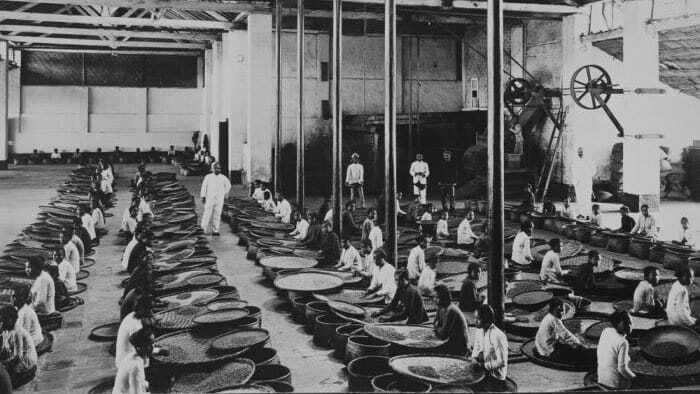
Panen kopi yang dilakukan di wilayah Parahyangan
Despite the many sufferings of the people due to Cultuurstelsel, the people of the Dutch East Indies still have a number of benefits that can be obtained and preserved to this day such as recognizing and identifying agricultural export crops including the process of empowering agricultural crops to be of high selling value. In addition, there is infrastructure development of agricultural supporting facilities and infrastructure ranging from production-distribution-consumption. The Postal Highway (Postweg) connecting Anyer-Panarukan became a supporting factor for Cultuurstelsel which had an impact on the development of cities / inland areas of Java Island.
Remnants of Cultuurstelsel farmland that can still be found today include Priangan coffee and tea plantations in the mountainous region of West Java and coffee and sugarcane plantations in East Java. In line with this, a number of Dutch colonial coffee, tea and sugar factories can still be found today. A number of these export commodity plantations are generally under the authority of PT Perkebunan Nusantara (PTPN) or private companies.
Today, PT. Suryo Riset Indonesia (PT. SRI) still does not cultivate export crops that became trade commodities in the 1830-1870 era, but PT. SRI always strives to cultivate various types of agricultural crops for the sustainability of Indonesian agriculture. We are adaptive to the needs of the community and the times!
Author:SRI Editorial Team
Editor: Social Media Division of PT SRI
We are always open to collaboration with partners who share our vision and passion in creating sustainable innovations and solutions. Together, we can realize projects that have a positive impact and provide real benefits to many parties. Feel free to contact us and start a successful journey of cooperation.